For sawing logs, boards, tree trunks in the garden, a chainsaw or electric saw is suitable. Choosing the right tool from these two options is not easy. These saws are similar not only in appearance, but also in design. Choosing what is more suitable for the fulfillment of tasks - a gas or electric saw, it is necessary to study the main characteristics of these devices, as well as their pros and cons.
Content
Chainsaw: features, pros and cons
In order to fully appreciate the advantages and disadvantages of a tool, it is necessary to familiarize yourself with its device, key characteristics and functions.
Chainsaw device
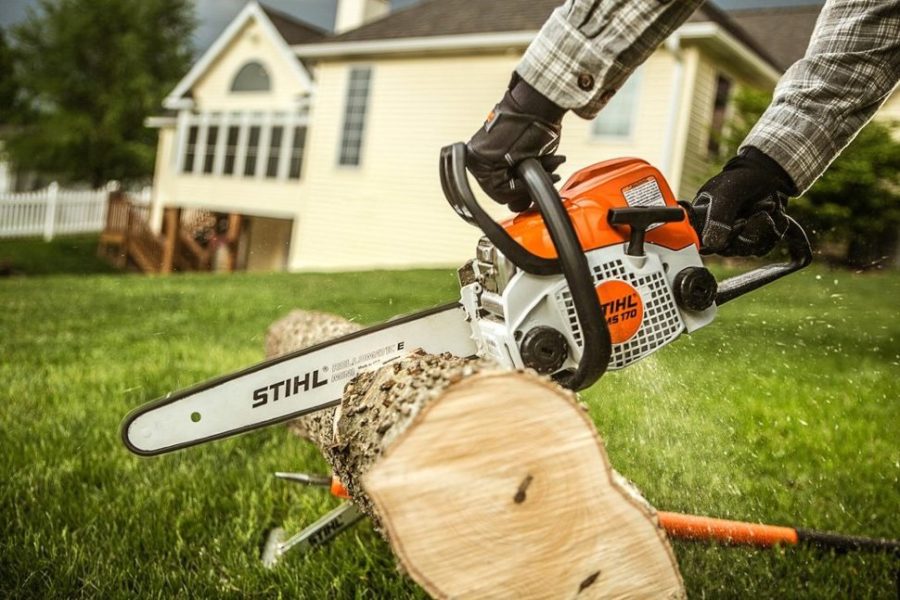
All chainsaws have a similar design and work on the same principle. The main external nodes of the tool:
- The case that hides the gasoline engine and the basic mechanisms that ensure its operation. Its top cover is removed, providing access to the fuel system, air purification unit. The engine in chainsaws use a single-cylinder two-stroke. Its dimensions and dimensions affect the power and determine the purpose of the tool.
- Two handles (front and rear). On the back is a start and lock button.
- Toggle switch Located next to the rear handle, it is responsible for turning the ignition system on and off.
- Saw knot. It includes a tire on which the chain is stretched, the chain itself, as well as a rotation transmission mechanism, a chain tension system and tire fasteners, closed by a cover.
- Launch system. It includes a starter and a hand pump button located in the side of the housing.
- Two tightly closed mouths. The fuel mixture is poured into one, chain lubricant into the other.
- Inertial brake. Provides instant tool stop and protects the operator from injury.
The location, shape and appearance of structural elements may vary depending on the model. Nevertheless, this design is typical and is used massively in the manufacture of chainsaws.
The principle of operation of a chainsaw
The chainsaw is equipped with an internal combustion engine and is connected via a transmission system to a saw chain. The engine and the chain are connected by a clutch key, which are metal pads pulled together by springs. When the starter button is pressed, the engine starts to run at speeds of up to 2700 rpm. (idling). With an increase in the number of revolutions, the springs of the clutch key are stretched by centrifugal force and the pads are pressed against the inner surface of the clutch disc. It begins to rotate with the gear wheel, to which the chain is attached, making 10 thousand or more revolutions per minute.
To ensure safety, there are 2 options for stopping the circuit:
- Engine shuts down. It takes 1-2 seconds to stop.
- The inertial brake is applied. When the lever is pressed, a fixed steel ring clamps the clutch disc, stopping the tool in 0.2 seconds.
The two-stroke engine does not require lubrication, it is enough to use a high-quality fuel mixture.
Benefits of Chainsaws
The main advantage of the tool is its autonomy. A gasoline powered saw does not need an external power source and can be used away from civilization. This device is capable of operating at low temperatures, as well as in conditions of high humidity, during rain.
Chainsaws are suitable for cutting trees in remote areas and sawmills, useful when building a temporary shelter or a tourist camp.
Chainsaw Disadvantages
The disadvantage of such devices is a complex startup system and time-consuming maintenance. Before starting work, it is necessary to prepare a benzo-oil mixture in the proportion specified by the manufacturer. The owner has to monitor the tension of the saw chain, the cleanliness of the filters and the breather on the tank cap (responsible for equalizing the pressure), and monitor the oil level, ensuring the uninterrupted operation of the headset. A large number of work nodes increases the likelihood of equipment failure.
Power saws: features, pros and cons
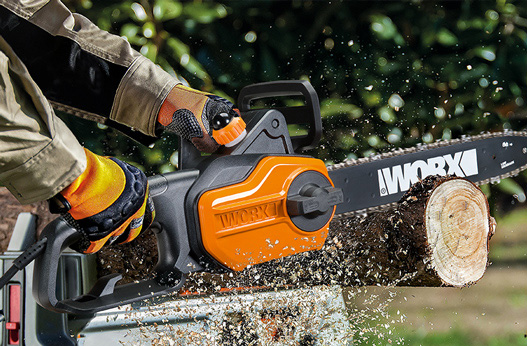
Electric saws are similar in appearance and design to gasoline models. However, there are a number of fundamental differences between these devices.
Electric saw device
Key tool nodes:
- Electric motor hidden in a plastic case.
- Oil tank and oil supply tank.
- Front and rear handles with start buttons.
- Emergency brake lever.
- Saw assembly including chain, bar and fasteners.
In electric saws, unlike gasoline counterparts, as a rule, there is no clutch disc. Instead, a soft start button is used, which allows you to gradually gain momentum.
The principle of operation of the electric saw
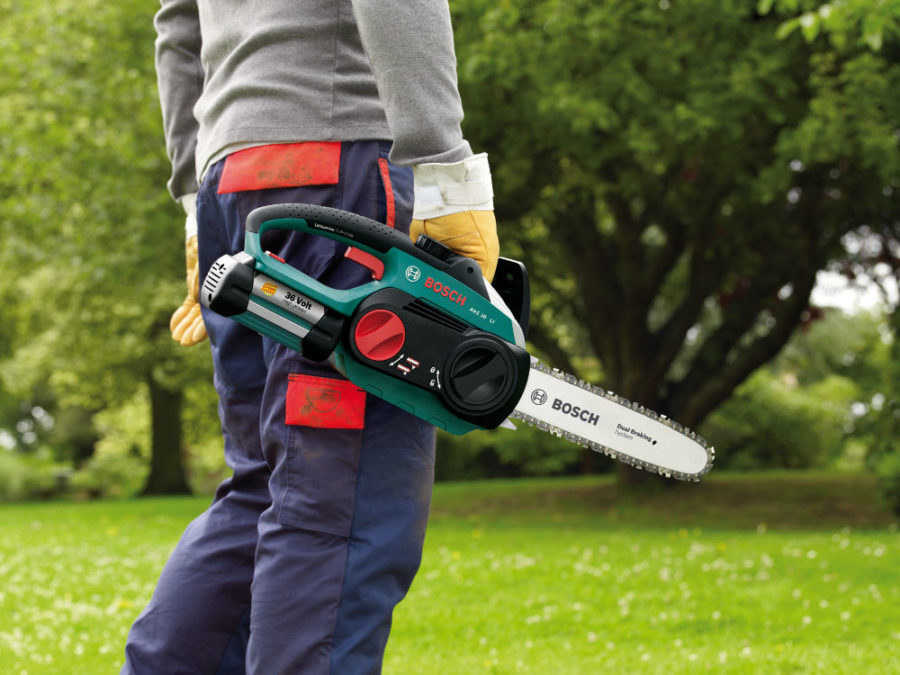
After connecting to the network and pressing the "Start" button, the electric motor starts to work, which creates rotational movements and transfers them to the canvas through a bevel gear or using a direct drive. The chain fixed on the tire starts to move, at the same time oil is pumped to it from the tank.
The advantages of power saws
Electric chain saws are very popular in everyday life. Their main advantages are:
- Compact size and simple construction.
- Easy start-up, independent of weather conditions.
- A small number of key nodes increases tool reliability.
- Low noise and low vibration.
Electric saws do not require prior preparation before starting work. The only thing the operator needs is to check the chain tension and the oil level in the tank.
Disadvantages of power saws
The main disadvantage of this tool is its binding to the power network and the limited radius of work. In order for the power saw to work away from networks, an autonomous generator is required. The cable length also limits the range of the device - to use a saw on the roof or in the basement you will have to use an extension cord.
Differences between saws
To get a complete picture of the possibilities of electric and chainsaws, it is necessary to compare their key characteristics.
Power and performance
The power of electric saws rarely exceeds 2.5 kW, and in gasoline models it reaches 5-6 kW. But even with equal power, the power tool will be inferior in performance, since it must be turned off for 20 minutes after 40 minutes of operation (on average) in order to avoid engine overheating. Gasoline does not require such stops, they are able to work continuously for 8 hours in a row (if you do not take into account devices of the lower price segment).
The revs of gasoline models are on average a quarter higher than electric ones. Accordingly, their performance and speed are higher.
Saw headset
The profile and pitch of the teeth of electric and gasoline saws are the same, only the number of cutters differs due to the difference in the length of the blade. Powerful models operating on petroleum products are equipped with tires up to 1 meter. However, such professional saws are used mainly in logging, ordinary household appliances are much more compact. Electrical devices are equipped with blades not exceeding 0.5 m.
Preparation for work
Electrical models are much easier to maintain. Before starting, it is necessary to fill in the oil, fix the headset and plug in the device.Many electric saws are equipped with quick-clamping devices that help tighten the chain in seconds.
For gasoline models, the preparation process takes more time and effort. Before starting work, it is necessary to prepare the fuel mixture by combining oil and gasoline in the right proportions. Mixing oil products ahead of time is not recommended - this deteriorates their performance.
Comfort and safety of use
Gasoline saws are well balanced and manoeuvrable. Unlike electrical models, operator movement does not limit the cable.
Electric models are divided into 2 groups depending on the method of engine placement:
- Longitudinal (axis of rotation of the shaft parallel to the tire). Differ in good balancing, big length and small thickness;
- Transverse (axis of rotation of the shaft perpendicular to the tire). The models are short in length, however, they have an imbalance due to the protruding motor housing. The operator has to make additional efforts to align the cut line, which with prolonged use can lead to premature fatigue;
Gasoline models can be used regardless of weather conditions. Electric - only in good, dry weather. It is unsafe to operate such a tool in the rain or immediately after it.
The likelihood of injury in case of a safety violation is the same in both cases and does not depend on the type of device.
How to make a choice
The deciding factor when buying a gasoline or electric saw will be the planned scope of work.
If you buy a tool for periodic work in the garden, for example, to cut old trees, put a gazebo or fix a bath, a gasoline or electric saw is equally suitable.
For long-term work in the open air, professional, productive chainsaws suitable for several hours without stopping are suitable.
If you have to work indoors, the electric version will be more advantageous. Under the roof, the device will be able to work regardless of the weather, low noise and lack of exhaust gases will play in favor of this option.


