 The year 2014 was marked by the release of smartphones such as Xiaomi Redmi Note of the first generation and Mi 4. They really began to conquer the market of mobile devices with a low price tag, which was what users liked. A more significant event was the appearance of the company's first fitness bracelet - Mi Band. Although its sales were not phenomenal, the product was a breakthrough.
The compact capsule in the strap in its functionality closely approached the majority of smart watches that existed at that time on sale. He could wake the user at the right time, notify of weak activity or an incoming call. But there was a significant drawback: the smartphone still had to be pulled out of your pocket in order to find out the exact time or from whom the notification came.
With the release of the second generation, the problem was partially solved. The design of the capsule and straps for it was radically revised, so that the bracelets were less likely to lose, and a small screen appeared on the device itself. Its functionality was reduced to demonstrating the time, the number of steps taken and notifications, but this was enough for most users.
This year they decided to renew the bracelet, since for more than a year and a half the second generation has remained relevant. It was difficult to imagine that the Chinese would come up with interesting things for implementation in the third generation, but they coped with this task. The release date of Xiaomi Mi Band 3 is May 31 of this year, and from that moment on, the price has already managed to decline. Should I buy a bracelet in current realities?
Content
Packaging and equipment
Previous generations of the bracelet were delivered in blank cardboard boxes. The color was natural cardboard in the case of the first Mi Band and white, if we talk about Mi Band 2. With the third generation, the creators of the package went further: the top cover is transparent, a capsule is visible through it, and everything else is white. The package bundle is not rich: a capsule, a black strap, a manual and a charger, which has become a bit wider when compared with the previous one.
Design
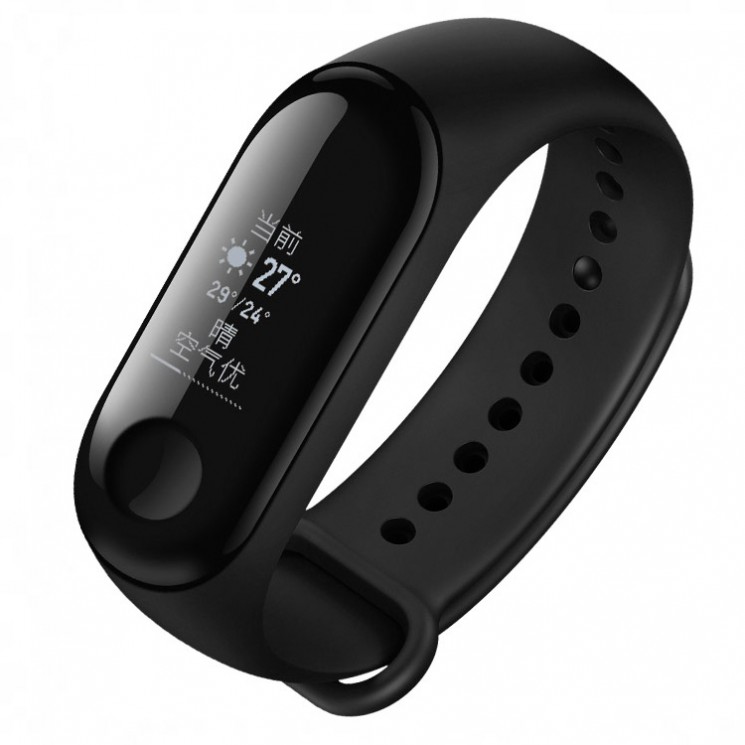
All previous generations of Mi Band are made in the form of a small capsule on which the strap is worn. The third generation is no exception: the capsule is made according to the old principle, but with a more modern design. Now it looks more streamlined and modern, since its edges are rounded, it has also become a little heavier, but still made of plastic, and recesses have appeared on the sides for more reliable fixing of the capsule in the strap.
On the top, judging by the layout of the logo, there is nothing at the end, connectors for the charger are located on the bottom, which has become a bit wider than the predecessor, on the left is the serial number of the model. On the right, too, there is nothing. The heart rate sensor is located on the inside of the bracelet, and on top is a touch screen under a rounded plastic glass with a notch. After the flat panel, the Mi Band 2 looks unusual.
On the OLED screen covered with slippery plastic, the finger glides well, but it seems that this is not for long. Plastic is not as durable as glass, but, nevertheless, it is much more difficult to make a web from it. Be that as it may, the first 2 weeks of use did not leave significant scratches on the surface of the bracelet, which means that it will survive the typical mode of use of most users.
Another feature of the watch is its protection against dust and moisture. Now the IP68 standard is applied here, thanks to which the watch can be immersed in water to a depth of 50 meters under one condition: it should not be salty. Many swimming enthusiasts will appreciate the possibility of playing sports without removing the bracelet. With the second band, many did the same, but the capsule, as a result, was often lost or wet.
Strap
The strap itself has practically not changed, except that it has become a little wider, like the capsule itself. The button-clasp also slightly changed the look, but it is almost imperceptible. The principle of the clasp remained the same: several holes were made in the strap, into which a special clasp is inserted. According to user reviews, the mount is unreliable and opens at the first contact with a foreign surface.
As for fixing the capsule, the manufacturer worked on it, and this can be seen immediately. First of all, on the capsule itself, as was written above, a special notch appeared, and on the strap there was a bulge. Thanks to them, the capsule is removed from the strap only from the inside, due to which the chance of falling out of the computing part of the bracelet is minimized. If he flies, then only with the strap. And this is not an exaggeration.
On the arm, due to the increased weight of the capsule and the width of the strap, the Mi Band 3 feels heavier than before. This is due to the increased battery, a new screen and another protective coating on the capsule and the large width of the strap. The latter, by the way, are presented in three colors: black, blue and red, and you can change them without problems. Third-party companies are not worth buying yet, as their quality leaves much to be desired.
Screen
If in the second generation of the bracelet the screen had a very small screen, then in the third its diagonal became slightly larger: 0.42 inches versus 0.78 for the new one. Along with it, the resolution also grew: now it is 128x80 pixels, but the picture did not become less grainy, since the pixel density remained the same. The screen, by the way, is made using OLED technology, but can only display a monochrome image.
Due to the increase in the screen, more information began to fit on it. For example, instead of a single-line display of the date in standby mode, the bracelet now shows the time, date and current number of steps taken. A sensor grid appeared on the screen, so instead of the button of the previous generation, there is only a small depression in the protective surface.
Management can be carried out using either a button or a touch screen. The first performs the “back” action and activates the screen, and the touch screen allows sweeping to change the displayed data. The image appears with a slight delay, but this is not a screen problem, but a performance issue. As for brightness - it is good, but only before going out in the sun. Like 2 years ago, it is impossible to read anything under the open sun.
Functionality
The functionality of the third generation Xiaomi Mi Band practically does not differ from those of its predecessor. The bracelet still knows how to count steps, measure heart rate, monitor sleep quality, display incoming notifications, show date and time. Functionality did not become a fundamental difference from its predecessor - only the way of interacting with the user changed.
First of all, more information is placed on the larger screen, so that on the main screen you can place not only the time display, but also the date, the number of steps taken and the distance traveled. In addition, the number of variations in the standby mode of the device has increased. Instead of one option, there are three of them. The menu items became a little more, and their display on the screen increased along with the last.
Navigation between them is carried out using a sensor grid, swipe. The recess under the screen has its own functionality: it can recognize short and long presses. As a rule, the action “back” is assigned to the short one, and activation of the selected mode to the long one. As a protection against accidental clicks, the screen can be locked, and it can be unlocked using a swipe up and down.
New menu items - weather forecast and stopwatch. They work primitively, and the location for specifying the forecast is set on the smartphone. For the normal operation of the mode requires constant communication with the phone via Bluetooth.The novelty also shows the steps in an unusual way: the screen displays a percentage of the daily rate of steps and the number of calories burned. Previously, this information was only available in the Mi Fit app.
Another useful difference between the third generation and the second is notification. During a call, the name of the caller will be visible on the bracelet, and the sound of the ringtone played on the smartphone can be turned off by a long press. You can also view notifications from different applications directly on the bracelet. Killer feature - the ability to search for a smartphone. In this mode, the mobile device will make a loud sound.
The bracelet is connected to the smartphone via the Bluetooth 4.2 interface, and an accelerometer is used for everything else. There is no GPS and a barometer, so it’s better not to remove the phone from your pocket while jogging. The connection is surprisingly stable, no gaps in two weeks of use were noticed. In addition, it is strange that the bracelet does not notify the connection is broken by vibration, it only shows the icon on its own screen.
A significant disadvantage for ordinary users will be the lack of global firmware. As is usually the case with Chinese devices, the first version is Chinese. It supports the Cyrillic alphabet, but its display on the screen is unacceptably poor: the discharge of letters is too large, and the font used has serifs. There are already custom firmwares, but they are not worth installing yet, since they do not differ in stability.
Stock global firmware will appear only in September, when the version of the bracelet with NFC for contactless payment appears on the market. According to company representatives, the system will work only in China. At least that will be the first time. If the Chinese manage to come to an agreement with local banks and they will launch the Mi Pay service in Russia and the CIS countries, then the bracelet will need to be bought urgently.
Pairing with smartphone
For this, the Mi Fit application is traditionally used. For several years of presence on the market, the application has acquired more functionality than just a bracelet and watch manager. So, with its help, you can monitor daily physical activity in detail, assign sleep phases, keep a training log, and also enter your own settings for the device connected to the application.
The most common functions of the application are turning on / off the alarm clock, the vibration of which, by the way, is felt even during deep sleep, control of small functions, as well as the choice of application for displaying notifications. In the case of Android, this can be a third-party notification aggregator, and in the case of iOS, you can select only one of the messengers. Also, Android users can use third-party applications to configure the bracelet.
Here, in the application, you can check the accuracy of the constructed route and check the mileage with the fact that you measured the bracelet by the number of steps. In general, the measurements are accurate, but with a small error, usually not more than 200 meters. Errors are also encountered when measuring the pulse: during training in the gym, the bracelet fails to accurately measure the pulse, but while running on the street, measurements are more or less similar to the truth. It is noteworthy that the bracelet cannot work in the constant heart rate mode.
Autonomy
According to the manufacturer, the autonomy of the Xiaomi Mi Band 3 bracelet will be comparable to that of its predecessor. The second generation, recall, held a charge of up to 20 days. Yes, there is a larger screen, a newer version of Bluetooth and more functions, but the battery here has increased to 110 mAh. For two weeks of use, 95% of the charge was consumed, but the bracelet was used in active mode.
If the heart rate monitor is turned on less often and the bracelet is not used during sports, then it may well live the manufacturer's declared 20 days. Charging it is carried out by means of a complete plug, which is very similar to the analogue of two years ago. When trying to insert the bracelet into the old charger, the first one did not fit there, and the second Band in the adapter from the third dangled and strove to fall out.
findings
A review of Xiaomi Mi Band 3 showed that fitness bracelets are increasingly penetrating the lives of ordinary people, and the use of smart watches a la Apple Watch seems irrational. Nevertheless, the new items from Xiaomi have both their pros and cons.
Pros:
- new design;
- protection against dust and moisture according to the IP68 standard;
- improved strap;
- the presence of a heart rate monitor;
- large OLED screen;
- autonomy;
- cost.
Minuses:
- button-fastening strap;
- display operation under the sun;
- a small number of changes relative to the previous generation;
- poor compatibility with accessories;
- separation of versions between different markets;
- untrustworthy screen protection.
So, the cost. At present, it is not so difficult to buy a bracelet in Russia: most electronics stores have already purchased lots of devices without NFC. Their cost is 3,500 rubles. This, of course, is expensive: the same Chinese sites like Aliexpress offer to buy it for more than two thousand on ordinary days and for 1,500-1700 rubles on sale days. The version with NFC will obviously be more expensive, but not by much: by 10-15%.
Should I buy Mi Band 3? Definitely yes. Moreover, this is the rare case when you need to upgrade, even if you have a second generation on hand. A large screen, an increased number of functions, a modern design - that's what Mi Band 3 is worth taking. It is not known how the situation with contactless payments will turn, so owners of the first and second generation are advised to wait until the fall and then decide whether this is a good alternative to its predecessors.