 Every year, oral irrigators are gaining more and more popularity among ordinary users. If before they were used only by dentists for professional purposes, now there are many compact models for the home. Regular use of this device helps reduce the risk of tooth decay and other common dental diseases. Which is better to choose an irrigator and how do they differ from each other?
Content
What is it and what is it for?
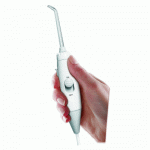
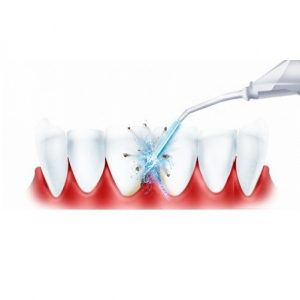
An irrigator is a functional device used to maintain oral hygiene. The cleaning takes place with the help of a powerful jet of water, which washes away food debris and light deposits from the interdental space. The irrigation process is painless and safe even for gums with increased sensitivity. The device is recommended to be used after thorough brushing with a brush.
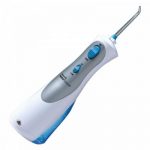
The oral irrigator is equipped with a small hydraulic pump, a drug reservoir, a convenient handle and several nozzles for different purposes. The built-in compressor provides the necessary rinse head pressure. The fluid may be supplied in a continuous, pulsating or atomized flow, depending on the type of device.
A high-quality device is able to shorten the healing period after implant placement, prevent the occurrence of periodontitis and gingivitis, thoroughly clean complex orthodontic structures, prevent caries and eliminate bad breath.
Varieties of Irrigators
All models of irrigators can be conditionally divided into three types according to the method of water supply: pulsed, single-jet and micro-bubble. Each of them has a different efficiency and functionality. We will discuss in more detail the types of irrigators:
- Mono-jet irrigators use a continuous powerful stream of water to clean the oral cavity. This technology was used in the first devices and is now considered obsolete.
- The pulsed type of irrigators also uses a powerful jet, but water is not supplied continuously, but with the help of frequent pulsations. This method is more effective than a regular mono jet.
- Micro bubble technology (aerator). The liquid is supplied in a continuous stream, but saturated with bubbles using an additional air pump. Upon contact with the gums and teeth, the bubbles burst and help wash out the dirt.
According to the type of food, irrigators are also divided into portable and stationary. Portable models have a built-in rechargeable battery or battery compartment. They are compact and suitable for long trips. Stationary irrigators are network-powered and large. If for road appliances the average tank capacity is 200 ml, then for stationary - 0.5-1 l.
Micro bubble cleaning technology
Micro-bubble type irrigators are capable of creating small air bubbles hundreds of times smaller than a millimeter in a liquid that retain their shape for a long time and burst only when they come in contact with the surface. A negative charge is retained inside the bubbles, attracting even the smallest particles of food. Pollution is literally split and does not require strong pressure for this, as in pulsed and single-jet devices. Microbubble technology is considered the newest and most effective among similar ones. However, such devices are more expensive than others.
Stationary irrigators
Stationary irrigators are considered the best choice for home use. They have larger dimensions than mobile devices, but are powerful and roomy. If several family members will use the irrigator at once, it is necessary to choose a model with a volume tank and several interchangeable nozzles. The kit always comes from two to five tips, but they are designed for different purposes (braces, crowns, fillings, etc.). If everyone in the family has healthy teeth and no orthodontic structures, then it is better to buy a few universal nozzles.
Portable appliances
In addition to stationary irrigators, there are also portable devices that differ in small dimensions and the possibility of autonomous operation. They can be powered by a non-removable battery or replaceable batteries. Such devices are great for traveling, long trips, they can be used in bathrooms without access to the network. The average operating time of a road irrigator is 7 days (with regular, but not continuous use). Some devices have enough power to replace a stationary irrigator, but their tank volume is still small.
Pros and Cons of Irrigators
Despite all the advantages of oral irrigators, their use has significant disadvantages. Most often, they are caused by a feature of the model or improper use. Here are some pros and cons of irrigators:
Pros:
- easy to clean food debris and plaque from even the most inaccessible places, such as tooth crevices, gingival margins, braces, etc.
- Massage the gums and improve blood circulation, thereby strengthening the teeth;
- irrigator is indispensable for people with braces, brackets and crowns, because only he can clean the space under them;
- Helps to get rid of pathogenic bacteria and unpleasant odors;
- prevents caries, periodontitis, gingivitis, etc.
Minuses:
- nozzles are recommended to be changed every six months, and this is an additional expense;
- you can not use a powerful head for sensitive gums;
- additional tips are quite expensive;
- not suitable for thick rinses.
How to choose an irrigator
There are many models of irrigators, and choosing a suitable device is quite difficult. Especially without knowledge of technical specifications and average prices. When buying a device, it is worth considering the principle of water supply, the method of supply, the number of additional nozzles and the ability to switch pressure. Here are the main selection criteria:
- The principle of water supply. According to the principle of water supply, oral devices are divided into single-jet, micro-bubble and pulsed. Mono-jet technology has long been out of date, so it is better to give preference to other devices. In comparison, microbubble models are considered the most effective, since they wash the dirt out of hard-to-reach places as gently as possible. Pulse irrigators cope well with plaque and pieces of food.
- Type of food. According to the type of nutrition, irrigators for teeth and oral cavity can be divided into stationary and portable. The first option is great for continuous use, as It has a large water tank and has increased power. They are powered by mains. Portable or, as they are also called, road models can be used in travel, because they are relatively light and compact. Such irrigators are powered by batteries or batteries.
- Number of interchangeable nozzles. Included with any irrigator are several interchangeable tips. It can be a nozzle for cleaning the tongue, orthodontic systems, implants for washing the nose, etc. The more nozzles, the more functional the device. But you should not spend money on special tips if you have healthy teeth.Better make sure that the device has a pressure adjustment.
- The number of modes. The irrigator should have several modes for cleaning. In modern models, there are from 3 to 10 operating modes. The water pressure must be regulated so that it is comfortable to use the device for each member of the family. In children, the gums are more sensitive than in adults, so they need minimal pressure. The same can be said about people with diseases of the oral cavity.
Also make sure that the irrigator is made of quality and safe materials. He must be certified and have recommendations from doctors. Choose popular manufacturers and order only in official stores. In order not to stumble on a fake.
Rating
Many manufacturers overcharge their devices or use low-quality materials. How to choose an irrigator if you do not understand the technical specifications? There is a solution: we compiled a rating of tested devices based on user reviews and ratings.
Introducing the top 2017-2018:
WaterPik WP-100 Ultra / WP-112 Ultra
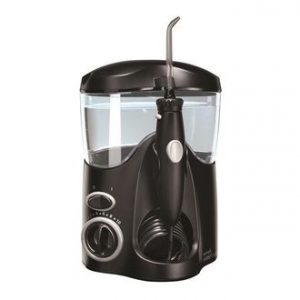
- Principle of operation: micro bubble
- Device power: from a stationary network
- Volume of a tank for medicinal fluid: 650 ml
- Maximum head pressure: 35-620 kPa
- Pressure adjustment function: yes, smooth
- Pressure Level Switch Function: 10 Modes
- Pulse Rate: 1200 pulses / min
- The presence of interchangeable tips: 7
- High build quality and body materials
- Easy to control and switch modes
- Convenient self-twisting cord
- Fairly high price
- Weak head
Functional irrigator connected to a fixed network. It has high power and flexible jet control (about 10 modes). Included are 7 handy nozzles rotating around its axis. Despite the powerful technical component, it has a low noise level.
AQUAJET LD-A8
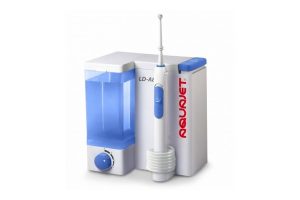
- Operating principle: impulse
- Autonomous work: no, from a fixed network
- Medicated fluid tank volume: 500 ml
- Pressure Limit: 810 kPa
- Pressure adjustment function: yes, smooth
- Pressure Switch Function: 4 steps
- Pulse speed: 1200 pulses / min
- The presence of interchangeable tips: 5
- Large fluid tank
- Cleans interdental space well
- High power
- Noisy work
Irrigator with bright children's design. It has simple controls, 4 power levels and high jet pressure (range from 290 to 810 kPa). Pulse water supply technology - 1200 pulses / minute. Quickly copes with any kind of pollution and helps get rid of bad smell.
WaterPik WP-660 Aquarius Professional

- Operating principle: impulse
- Device power: from a stationary network
- Volume of a tank for a medicine or rinse aid: 650 ml
- Maximum jet pressure: up to 690 kPa
- Pressure adjustment function: yes, smooth
- Number of switchable modes: 10
- Water ripple frequency: 1400 pulses / min
- Interchangeable tips: 7
- Washes food residues well even from interdental crevices
- High adjustable pressure
- Massages the gums
- Short cord
A new model of irrigator from the manufacturer Waterpeak. It copes well even with old plaque, thanks to its high power and good pressure. Has a set of 7 interchangeable nozzles for various applications. Suitable for both individual and family use.
Panasonic EW1211A
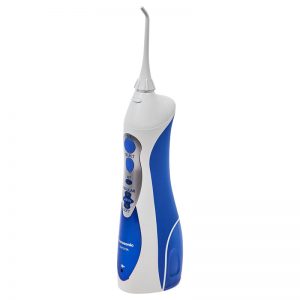
- Principle of operation: micro bubble
- Autonomous work: from the accumulator
- Liquid tank volume: 130 ml
- Maximum head pressure: 200-590 kPa
- The ability to adjust the pressure: yes, step
- Number of modes: 3
- Battery Life: 15 minutes
- Water ripple frequency: 1400 pulses / min
- The presence of tips in the kit: 2
- Compact body
- Three operating modes
- You can attach the device to the wall
- Low pressure
- Duration of work
Wireless irrigator with a long service life (from 5-7 years). Ideal for traveling and long trips. There is enough fluid in the tank for one cleaning. Included are 2 interchangeable nozzles.
Philips AirFloss Ultra HX8432 / 03
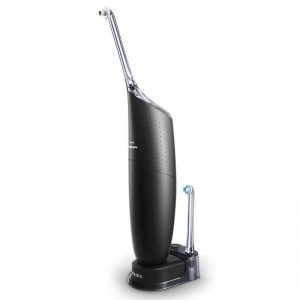
- Principle of operation: micro bubble
- Device power: battery
- Water tank volume: 15 ml
- Maximum head pressure: 275-620 kPa
- Pressure adjustment function: yes, step
- Switching pressure level: 3 steps
- Number of interchangeable tips in the kit: 2
- Stylish case design
- Convenient Charger
- Small water tank
- Cleans nothing
- Long charging time
Lightweight and versatile device for removing plaque and food debris from the interdental space. Allows you to clean the entire oral cavity within 60 seconds. Uses compressed air and small droplet technology.
VES Kenwell VIP-006
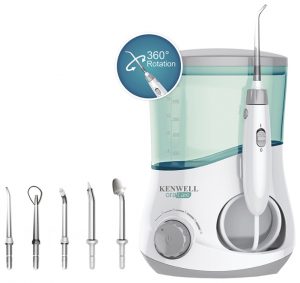
- Operating principle: impulse
- Autonomous work: from a stationary network
- Water tank volume: 600 ml
- Maximum head pressure: up to 750 kPa
- The ability to adjust the pressure: yes, step
- Ability to switch the pressure level: 5 steps
- Battery Life: 30 minutes
- Number of interchangeable tips in the kit: 5
- Convenient rotating nozzles
- There is a nasal nozzle
- Lightweight body
- Not found
Convenient device for the care of oral hygiene. It has adjustable jet pressure and 5 interchangeable rotating nozzles. The capacity of the water tank is 600 ml.
AquaPick AQ-300
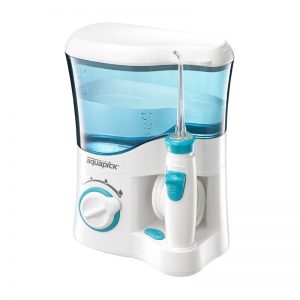
- Operating principle: impulse
- Food: from a network
- Rinse aid tank volume: 600 ml
- Maximum head pressure: up to 686 kPa
- The ability to adjust the pressure: yes, smooth
- Number of pressure levels: 12
- Duration of continuous work: 30 minutes
- Pulse Rate: 1800 pulses / min
- The presence of tips in the kit: 4
- Convenient pressure adjustment
- Compact body
- Powerful pressure
- It is difficult to fill the tank with water
- The top cover is loose
Universal irrigator with infinitely variable pressure control (12 levels). It has low power consumption at 24 watts and a high pulse rate of 1800 pulses / min. Power comes from a stationary network.
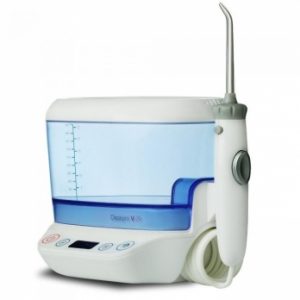
Matwave Clean Pro V-20
- Operating principle: impulse
- Power supply: from a fixed network
- Rinse aid tank volume: 900 ml
- Maximum head pressure: up to 890 kPa
- The ability to adjust the pressure: yes, step
- Number of pressure levels: 10
- Pulse Rate: 1800 pulses / min
- The presence of tips in the kit: 5
- Volumetric tank for water or medicine
- There are 5 convenient nozzles included
- Perfectly cleans leftovers from braces
- Legs glide
- Short tube
Professional device for washing out food debris and removing plaque. The irrigator has a convenient electronic control and a magnetic pen holder. Of the features - a long warranty period of 3 years from the date of purchase.
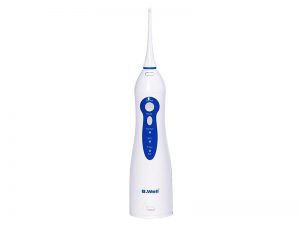
B.Well WI-911
- Operating principle: impulse
- Power: Battery
- Rinse aid tank volume: 135 ml
- Maximum head pressure: 275-620 kPa
- The ability to adjust the pressure: yes, step
- Number of pressure levels: 3
- Duration of continuous work: 30 minutes
- Pulse Rate: 1600 pulses / min
- The presence of tips in the kit: 2
- The battery lasts for a month of use
- Easy to use
- The tank is filling up fast
- Small capacity for water
- The stub is quickly lost
Compact and lightweight oral irrigator. It has two convenient interchangeable nozzles with 360 degrees rotation.The device is also equipped with a capacious battery and a small reservoir for liquid. The battery life of the irrigator is enough for several weeks of regular use.
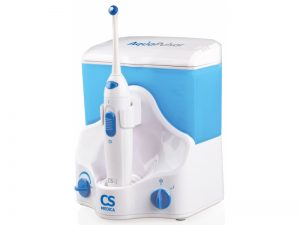
CS Medica AquaPulsar OS1
- Operating principle: impulse
- Food: from a network
- Rinse aid tank volume: 500 ml
- Maximum head pressure: 800 kPa
- The ability to adjust the pressure: yes, smooth
- Number of pressure levels: 2
- Pulse Rate: 1800 pulses / min
- The presence of tips in the kit: 4
- Thanks to its high power, it quickly flushes out any dirt
- Good ergonomics
- Affordable cost
- High water consumption
- Noisy work
The budget model of the irrigator for home use. It has high power and pressure control. There is also a spray mode, which helps gently and painlessly get rid of pollution even with gum disease.
To summarize
Hand-held irrigator is an indispensable oral care device. It helps to clean even the most inaccessible places of excess food and plaque. When choosing, it is worth considering the volume of the tank, the maximum power and the ability to adjust the pressure. Have a go at the devices of popular manufacturers so that the service center is located in your city. The optimal warranty period is 2 years from the date of purchase. Following these recommendations, the device will last a long time and effectively for the whole family.