Today was presented the long-awaited frameless smartphone from the Chinese manufacturer Vivo, built on the basis of the APEX spring concept. The frames around his screen are the thinnest among all devices: the useful area of the front panel thanks to him is 91.2%. The unusual location of the front camera, an interesting solution with the placement of the speaker, a dual camera and a top filling - this is what makes it interesting.
Vivo NEX Screen
 The highlight of the program is a 6.59-inch screen made using Super AMOLED technology. The resolution was 2316 × 1080 pixels, which corresponds to an aspect ratio of 19.3: 9. The thickness of the frames on the sides of it is 1.71 mm, on top - 2.16, and on the bottom - 5.08. The manufacturer had to leave a small chin due to the peculiarities of connecting the matrix to the motherboard. However, no one has thinner frames now.
To implement this idea, the engineers had to make a number of non-trivial decisions. The front camera here extends from the upper end, since it was not possible to place it under the screen. Its response time is just over a second, and the mechanism is able to work out up to 50 thousand activation. A fingerprint scanner is hidden under the display, which has become 50% more accurate and 10% faster than the first prototype. The speaker uses oblique conduction technology. Something similar was implemented in Xiaomi Mi Mix and Sharp Aquos Crystal.
Vivo NEX Enclosure
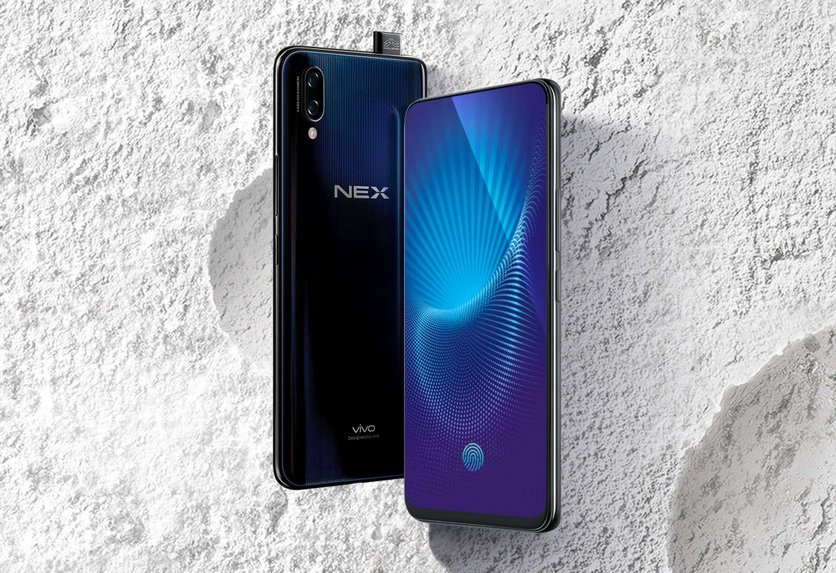 There are 4 physical keys on the metal frame: 3 on the right and one on the left. Apparently, the lone button on the left side is responsible for launching the analogue of Bixby and Google Assistant from Vivo - Jovi assistant working in Chinese. The glued rear window has an engraving of a large number of points, because of which it plays in different colors when deviating from its normal position.
Characteristics of Vivo NEX
Technically, the novelty is presented in two versions. The eldest, NEX S, runs on the basis of Qualcomm Snapdragon 845, equipped with 8 gigabytes of RAM and up to 256 GB of internal storage. NEX A is equipped with a simpler processor of the same manufacturer - Snapdragon 710, as well as 6 gigabytes of RAM and 128 ROM. Both versions are equipped with a 4000-milliampere battery and an artificial intelligence system.
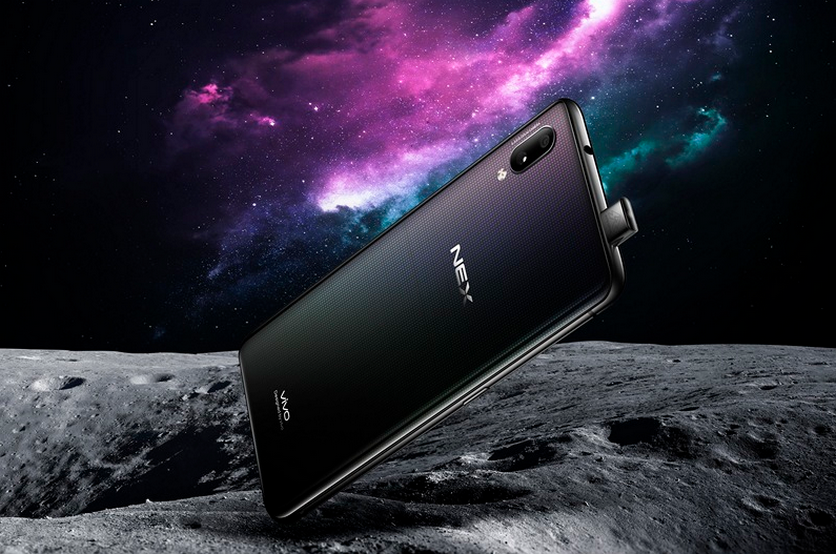 The cameras are represented by three sensors: 2 at the rear + 1 at the front. The rear camera is equipped with 12 and 5 megapixel sensors, aperture F / 1.8 and F / 2.4. The front module has an 8-megapixel sensor with an f / 2.0 aperture. The first deliveries of new products will begin in late June. Vivo NEX S is estimated at 4,998 yuan, about 49,000 rubles, and NEX A at 3,898 yuan, or 38,000 rubles.


