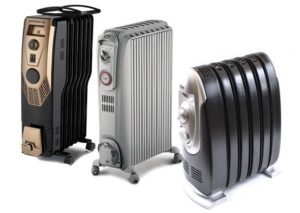
 Among those who, for some reason, need additional heating of the room or simply do not have a basic one, there are always disputes on the topic: which is better - a fan heater or an oil heater. There is no single answer to this question. However, we will try to show the capabilities of both classes of devices that are used under the same conditions, to highlight their advantages and disadvantages.
Content
General requirements for space heating
There are clear criteria by which you can immediately assess the capabilities of a particular appliance. For example, for an unheated room, these indicators look like this:
- with an area of up to 6 square meters - 550 watts;
- from 7 to 9 - 750 watts;
- from 10 to 20 - from 1000 to 1750.
To heat a room with an area of more than 20 squares, a heater with a power of 2 kW and above is needed. We will try to determine which class in this case, based on a comprehensive analysis of the capabilities of the devices.
What is an oil heater
The oil heater is a sealed housing made of stainless metal alloys. In high-quality products, these are aluminum-containing compounds, cheap Chinese products sin using simple steel, and calculation is made for tightness (the radiator does not rot from the inside) and an external protective coating.
Immediately it is worth noting - the product of the middle and high price range will have the best combination of price and service life.
The principle of operation of the oil heater is quite simple:
- inside the sealed metal case, which consists of separate blocks (for a large area of contact with air), there is transformer oil;
- after turning on the device, the electric heater or their group heats the coolant;
- when the oil temperature reaches the value set with the regulator, heating stops;
- after the oil has cooled down a certain number of degrees, the heating elements are switched on again and the temperature set by the user is returned to the coolant.
The oil cooler is self-sufficient. Depending on the volume, the warm-up time may vary. But after the device has entered the operating mode, it shows excellent characteristics of economy and efficiency. TENY turn on for a short time, the radiator almost always has the same temperature.
How the fan heater works
The fan heater also does not differ in complexity. Here a heat source is a red-hot spiral or thin metal plates.
When blowing air, it heats up and enters the volume of the room. The general principle of operation is similar to the mechanics of an oil cooler:
- at start, the fan heater reaches the technical maximum;
- voltage supply for heating fuel metal parts is supplied until the temperature regulator fixes the average temperature in the housing set by the user;
- a complete cessation of energy consumption does not occur - the fan runs continuously.
But there are key differences between the two classes, which will be mentioned later. Here we note the main thing: the fan heater is strongly attached to the air flow, if it is impossible to supply the full volume to the airflow, the device will turn off due to the operation of the internal protection against overheating, giving noticeably less heat to the room than stated by the manufacturer. The covered fan heater will not be able to "survive", unlike an oil radiator.
Round one. Comparison with the position of price and convenience
The first thing that the user evaluates is the usability of the appliance and its safety.The average potential owner of this rating is enough to decide what is best to buy - a fan heater or an oil heater. At the same time, energy consumption and the cost of long-term operation are not taken into account. Therefore, we make a direct comparison.
- Noise level. Net loss of fan heater. Although modern models are equipped with horizontal fans or screw turbines, the noise level is significant. The fan heater does not shut up, this contributes to the development of fatigue, a decrease in concentration, and human attention. In addition, with the course of use, the device becomes dirty and starts to make noise more and more.
- Switching modes. Speaking as accurately as possible, both classes of heaters emit clicks, crackles. But with a high-quality oil heater, uncomfortable noise occurs only when, for example, it was stored upside down or lying down. After installation in an upright position, the time for gurgling and crackling is short, the device quickly enters the mode and the only sound that is made is the soft start clicks issued by the thermal relay. The fan heater loudly clicks relay groups much more often. At the same time, a large voltage is switched, the sound is distinct, quite loud, in addition, many models simultaneously increase the speed of the fan motor.
- Overall reliability. Failures of the device have an important role, and here the fan heater is a frank outsider. He has two protection groups in terms of temperature, heaters are constantly burned out, the lubricant is depleted - the fan group, and regulators are oxidized and dried. A good oil cooler has only two bottlenecks. A bimetallic plate in the regulator that oxidizes or bursts after ten years, as well as a universal fuse for temperature and pressure - in case of any malfunctions associated with overloads and violation of oil pressure, it blocks the operation of the device and must be replaced.
- Safety of use. Fan heater - lightweight, often not equipped with a position sensor. It is easy to brush it off, drop it, break it. However, there is no guarantee that it will stop working. And this causes an additional possibility of fire of objects, short circuits, electric shock. The oil cooler is durable, heavy, solid. It is difficult to drop it, damage it, touch other objects with it. But the heated elements of the fan heater are covered with grilles, and you can touch the heating block of the oil radiator with a temperature of up to 90 degrees. Therefore, in terms of safety of use, both classes have their niches, where each of them is able to win.
- Microclimate. The fan heater loses with a loud bang. It burns oxygen. In addition, dust is constantly sucked into it, burns out on a spiral and emits an unpleasant odor. The oil cooler has no problems. Modern models equipped with a humidification unit are able to improve the microclimate, including saturating the air in the room with aromatic oils.
- Humidifier nozzle, can be used to dry clothes. Comparison can be carried out for a long time. The undoubted advantages of oil radiators, the gain in many positions are visible during operation. But when choosing a model in the store, the fan heater wins, it is cheap, lightweight, compact, you can buy a model of any power.
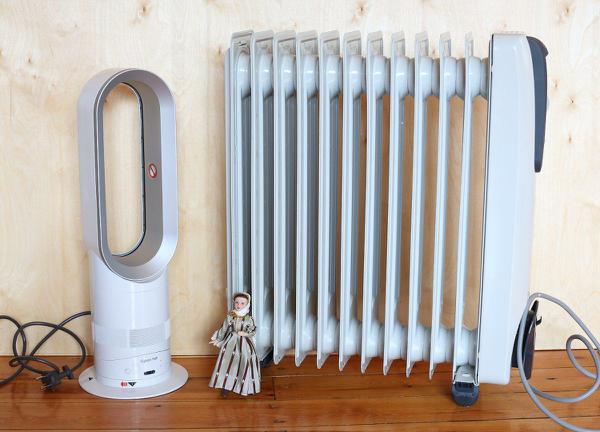
The last round. Long-Term Performance
To understand what is still better, consider the indicator of the cost of long-term operation.
- Power consumption. Equal in power, the fan heater and oil heater radically differ in monthly energy consumption. The first one has a constant minimum level, the fan does not turn off. The second - an exact amount of time works, which is lower, the lower the level of heat loss in the room. But the performance of the oil cooler is stable.And the fan heater over time begins to consume more and more - the heating elements become clogged, become thinner, to create a certain amount of heat you have to work more in the heating mode.
- The quality of heating. The repeatedly confirmed fact is that the oil cooler shows the best results in conditions of constant heating of the room. After entering the operating mode, the air in the room is stable, as is the average oil temperature in the heater. At the same time, more feedback is required from the fan heater - the constant movement of air and a drop in humidity does not contribute to the formation of a sensation of heat. It takes much longer to warm the room.
- Heating rate. There is a popular belief that the fan heater warms up the room faster to a minimum comfortable temperature. In a pure comparison of the classical classes of devices, this is so. But today, manufacturers of oil radiators offer plate-blowing models that, until a room reaches a comfortable temperature, literally turn on turbo mode, not inferior to fan heaters.
- Life time. As mentioned above, the number of nodes subject to constant wear and tear is many times higher for the fan heater. A complete failure, after which it makes no sense to carry out repairs, occurs relatively quickly. In an oil heater, the concept of senselessness of repair can only be in the case when the radiator simply rotted. And for models of the middle and high price range, this is theoretically achievable only after decades.
As can be seen from the above, the cost of long-term operation oil heater leads by a huge margin. It just works, works and works. The service life to failure is very large, the repair cost is small. A fan heater that constantly works literally for wear cannot even boast of a comparable operating time until a repair is necessary.
Conclusion
As you can see, the choice of a particular class of heater is dictated by the appropriateness of use in specific conditions. If the room is small, you will not have to stay in it for long, you want to move the device or put it under your feet, while the noise does not matter - the fan heater wins the competition. But if you want to have a constantly heated room in which a good microclimate and, in addition, the period of use of the device are estimated in months, it is better to simply not find an oil radiator.


