 Do you want enough heater power to warm you on the coldest winter evenings? Then it is worth approaching the choice responsibly. Before buying, it is better to familiarize yourself with a number of parameters of devices of various types, take into account the footage of the heated room, as well as factors such as absence / presence of thermal insulation, wall thickness and the maximum difference between outdoor and room temperature in the coldest time of the year. In the event of an error in the calculations, you risk purchasing a heater with more power than necessary (which will result in overpayments for electricity), or, conversely, a device with less power, which is not able to efficiently heat the room area.
Content
Types of electric heaters, their differences from each other
Electric heaters come in many forms, each of which has its advantages, disadvantages, principle and speed of action.
We list some of them:
- Thermal fan - such a device is somewhat reminiscent of a conventional fan, but an incandescent spiral is placed in front of its blades, which provides heating for that part of the room where the air flow is directed. Despite the fact that the fan heater is quite effective, it is not intended for continuous heating of the room. A significant drawback of such a device is the short-term result of its environmental impact.
- The ceramic heater, by the principle of operation, is very similar to a fan heater, only ceramic plates act as a heater. Such models work on gas and from the mains, there are floor, wall and even desktop. The main advantage of a ceramic heater is the preservation of humidity in the room.
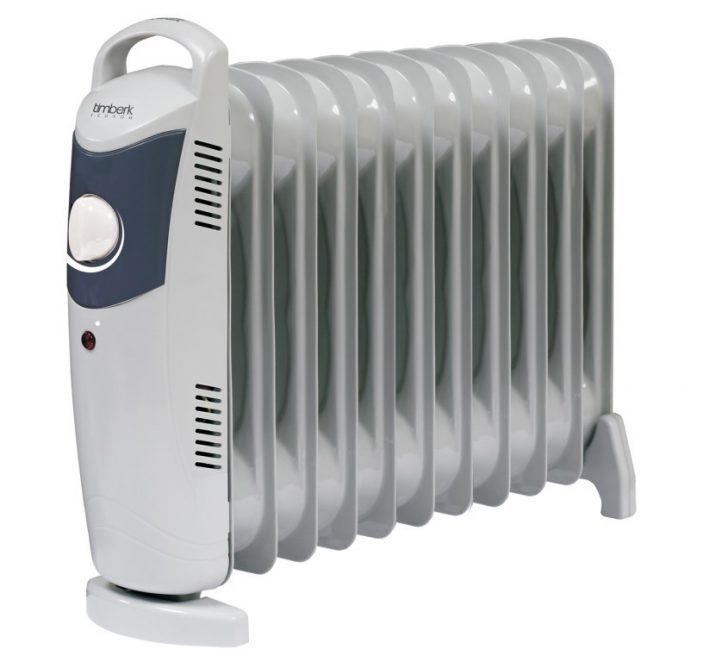
- Oil type radiator copes with heating the air in a very short time, but it should not be purchased if there are animals or small children in the house, since both of them risk being burned. Such a device is not considered the most economical option - it consumes a lot of electricity.
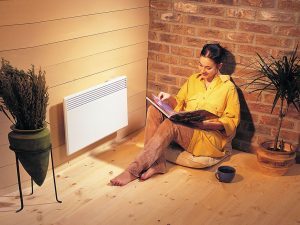
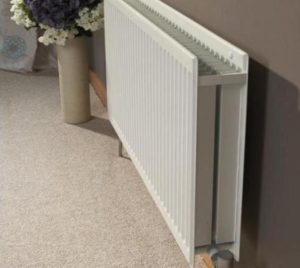
- Electric models heat the air to the desired temperature quickly enough, and they cool slowly. The basis of the principle of operation of these devices is convection. In the lower part of the device there are parts that suck in air, heating occurs due to the operation of a heating element - a tubular electric heater, the volume of the heated gas directly depends on its area. That is why the heater is often produced with a ribbed surface. Advantage convector in front of the oil heater is that the temperature of the coolant rises with greater speed, which means that you do not have to wait until the room warms up. In addition, these devices are much more compact. Wall models are especially popular.
- Infrared heater. The operation of devices of this type is based on electromagnetic radiation - at the same time, objects that fall under the influence of waves are heated first, and then the air itself. The structural elements of the device are also TENy. Another option is open spirals, sometimes protected by quartz tubes, or metal grids, plastic panels with holes or a carbon coating. In rooms, the heater is protected by transparent partitions or metal grids. Infrared heaters come in many types. Depending on the wavelength, they are divided into short-wave, medium- and long-wave, from the energy source - electric, gas, diesel and water, from the installation method - mobile and stationary.
How to calculate the power of the heater?
All modern appliances are equipped with thermostats that allow you to maintain a certain temperature.The type of heater itself has little effect on its performance - it is important to make the correct calculation.
To warm the air in the apartment, it is necessary with the help of a convector to maintain the air temperature with a specific heat capacity.
When calculating the heater power, the following indicators are taken into account:
- The minimum street temperature in the winter.
- Comfortable temperature in the room.
- Air density - 1.3 kg / m3.
- The heat capacity of the air is 0.001 MJ.
- Heat 1 MJ - 0.277 kW / h
The amount of heat required to heat a particular room can be calculated by the formula: c = Q / m (t2 - t1), where c is the specific heat, Q is the heat, m is the mass of air.
We transform the formula, it turns out: Q = c * m * (t2-t1), now you need to find out the mass of air in the room.
The formula for its calculation is simple: m = ϱ * P * h, where ϱ is the density of air, P is the area of the room, h is the height.
Thus, the heat consumption formula takes on the formula: kWt = 0.277 * c * ϱ * P * h * (t2-t1).
So, you can calculate the approximate energy consumption for heating a small room (40 sq. M with a ceiling height of 3 m. At a minimum temperature of 10 and the required +20).
kWt = 0.277 * 0.001 * 1.3 * 3 * 40 * 30 = 1.29636 (kW / h).
Heat loss
There are several reasons why heat leaves the room:
- ventilation;
- thermal conductivity of walls, windows, ceiling, etc .;
- radiation.
According to the norms of SNiP, the approximate volume of fresh air circulation is 20 square meters. m per hour. To warm the newly arrived cool air, an additional amount of energy is needed. The calculation is carried out according to the same formula: kWt = 0.277 * 0.001 * 1.3 * 20 * 30 = 0.21606 (kW / h).
The formula for calculating heat loss is as follows: Q = λ * (t1-t2) * S / L, where S is the wall area, L is the wall thickness, λ is the thermal conductivity coefficient, which is individual for each material.
For example, for a brick, λ = 0.5 W / (m * C), wall length = 8 m, height = 3 m, wall thickness = 0.5 m.
S = 4 * 8 * 3 = 96 sq.m.
Q = 0.5 * 30 * 96 / 0.5 = 2880 (W) = 2.88 (kW).
Thus, heat losses already exceed the required energy consumption for heating the premises without taking them into account. But do not forget that it is still necessary to take into account the indicator of the roof overlap, and there the heat loss can reach several tens. It turns out that to maintain a normal temperature in the room requires almost fifteen times more electricity than for its "clean" heating.
Accounting for thermal insulation
Thermal insulation plays a significant role in calculating the required power. For example, a mineral wool layer of 2 m will significantly reduce heat loss, λ = 0.06 (for the above parameters):
Q = 0.06 * 30 * 40 / 0.2 = 360 (W) = 0, 36 (kW).
When calculating the heat loss of the floor, it is taken into account that the soil has an initial temperature of about 5 degrees heat.
If the room is isolated, then an average of 3 to 5 kW will be needed to compensate for heat loss. Calculation of your own example can be done using the above example, data on specific materials can be easily found in directories.
How to choose a heater?
After making the necessary calculations, you should choose a device according to the maximum power indicator with a small margin - multiplying the coefficient obtained as a result of the calculations by 1.2, especially since all modern models have a thermostat.
A powerful device will warm the room faster. Curtains, which serve as a kind of heat insulator, will help to keep warm. For convection heaters, it is necessary to create conditions for free air circulation.
By choosing a device using calculations, you will avoid unnecessary waste of money.