For those who have already moved from urban high-rise buildings to their own comfortable home, the issue of heating in winter is rather acute. As you know, the cheapest fuel at the moment is gas. So in this article we will consider what types of gas heaters are, their advantages and disadvantages.
Content
Principle of operation
So, for starters, it's worth figuring out what gas heaters are and how they work.
All models have common component parts, namely:
- housing;
- heat exchanger;
- heater;
- burner.
These elements are in all gas heaters - from budget to the most modern.
More expensive models have added parts for convenience, such as a thermostat or auto shut off.
There is another common point for all models - they work from gas, natural or liquefied. Using the device, fuel is converted to heat. You can connect such a heater to both main gas and cylinder gas.
Varieties
All gas heaters are divided into portable and stationary.
The former are usually used temporarily, that is, from case to case. They are small in size and weight, most often put on the floor. Their performance, of course, is less.
Such gas heaters are usually chosen for premises for economic purposes or for giving, as well as in the absence of main gas supply. Such a unit will not stand a full and constant heating of a residential building.
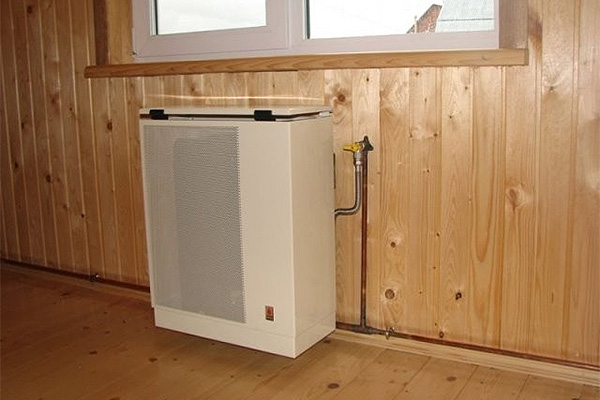
The second (stationary) gas heaters are devices that operate on main or bottled gas. These devices are installed only in a permanent place and will completely cope with winter heating at home. Such heaters are large, powerful and require additional equipment as a chimney.
Still gas heaters are divided according to the principle of action. There are three main categories:
- infrared;
- convection;
- catalytic.
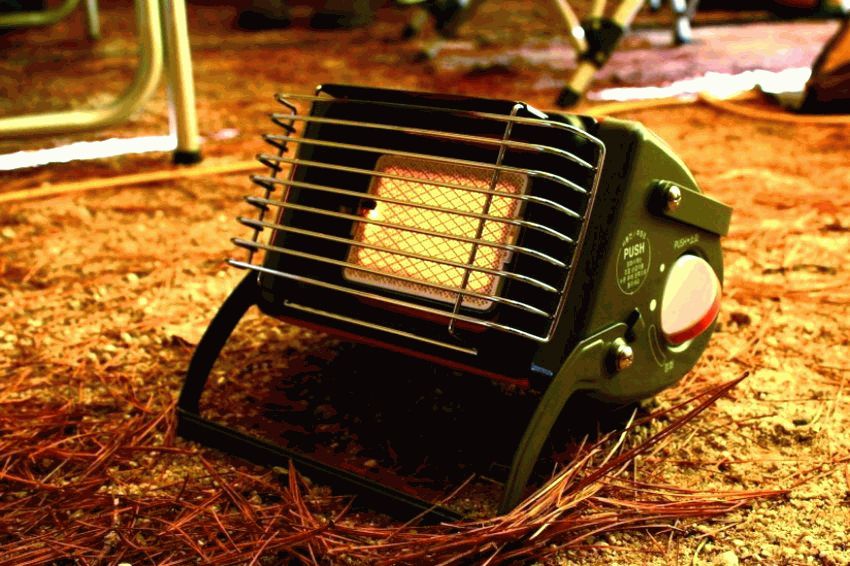
- The principle of operation of infrared heaters. Inside the housing are burners with emitters of metal or ceramic. When heated, they begin to radiate heat - infrared waves. Those, in turn, do not heat the air, but objects located at a certain distance from the heat source. Such devices, depending on the power, can heat large rooms and even open spaces.
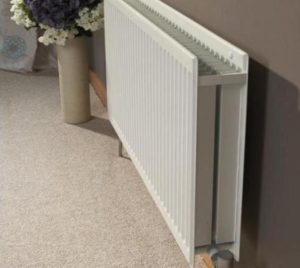
- The principle of operation of convection heaters. Here is the simplest device. Roughly speaking, these are ordinary burners that burn gas. The resulting heat passes into special finned radiators. Thanks to convection and according to the laws of physics, heated air rises, and cold takes its place, gradually warming up. If the correct power for the room is selected, heat is felt after a couple of hours.
- The principle of operation of catalytic models. These are perhaps the most fireproof gas furnaces. The combustion process is not provided here. Heat is generated as a result of a chemical reaction - gas oxidation. Fuel enters the catalytic panel, where it is oxidized, generating heat. The heating itself is infrared, convection or mixed type.
Pros and cons of different types of gas heaters
A large selection of different models often just leads into a stupor. Which heater will be better? Unfortunately, there is no definite answer, each of the types is somehow bad, but something good. To choose the unit that is suitable specifically for your needs, you need to familiarize yourself with their pros and cons.
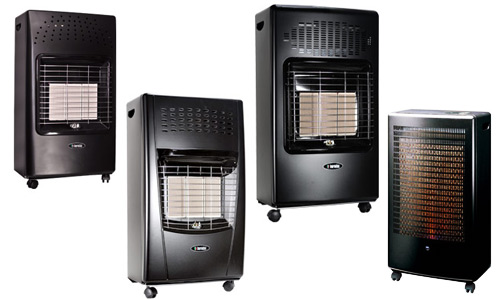
To study convection heater we will not, as there are more modern and safer models.Instead, consider a new generation ceramic gas heater. Below are tables with positive and negative characteristics of each type.
Catalytic
| pros | Minuses |
| Very compact. The principle of operation allows you to make the size of the device minimal. | Cannot be used in enclosed spaces. Necessarily good ventilation. |
| No additional pipes and dirt, as there are no combustion products. | |
| To operate the device does not require electricity - it is completely autonomous. | |
| Economical fuel consumption. | |
| Security. There are no burners or open flames. |
These appliances are very effective. As indicated above, heating can occur in three ways. Some models are additionally equipped with fans for even heat distribution.
Infrared
| pros | Minuses |
| Possibility of heating open and closed spaces. Such models are great for cafes, playgrounds or pool areas. | Burns oxygen. That is, ventilation in any case is necessary. |
| Large coverage area - street models can heat objects up to 6 meters away. | Low fire protection. Even with the maximum protective measures applied by the manufacturers, the device may cause a fire. |
| Mobility. Lightweight and compact models. | |
| High efficiency. | |
| In most cases, the operation of the device is completely autonomous. |
Ceramic
| pros | Minuses |
| Easy to operate. | It requires regular maintenance, and this is not an easy task. The list includes: calibration, filling the cylinder, cleaning the main parts and checking for wear. |
| Mobile and compact. | |
| Reliable. | |
| It is economical in comparison with liquid-fuel analogues. | |
| Heats the room very quickly. | |
| Is safe. |
What you need to know when choosing
And yet, how to choose a gas heater? First you need to know exactly the purpose of the heater.
So, for an open area (sites and other things), a unit in the form of a high lamp is recommended. It will heat a circular zone, for example, a terrace, a playground or a pool area.
Choosing a gas heater for a summer residence, it is worth paying attention to floor models.
For residential premises, a device with a catalytic principle of operation is more suitable. This is the safest option for others.
If possible, it is worth paying attention to stationary gas heaters. These are ideal for home year-round living.
Infrared or catalytic - which is better?
With such a large selection of models and about the same combination of pros and cons, the question often arises: which gas heater is better - infrared or catalytic?
Here the answer will be unequivocal: if the area of the heated room is less than 20 square meters, it is worth taking a closer look at the models that work on the catalytic principle.
With a larger area infrared models will be preferable.
The best gas heaters
In order to help you with a little choice, we present an overview of the best gas heaters in different categories.
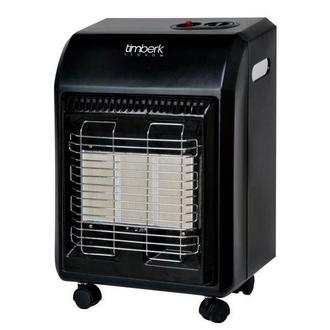
The first place in the ranking of mobile heaters for summer cottages is occupied by the model Timberk TGN 4200 SM1.
Main characteristics:
- floor;
- heats up to 60 cubic meters m;
- power 4.2 kW;
- closed;
- weight 7.4 kg;
- electric ignition;
- gas control;
- three burner operating modes.
Powered by a gas cylinder, which is installed in a metal case. The delivery includes a hose, gearbox and clamps.
Also, a CO2 sensor is installed in the device, there is protection against capsizing. Convenient to move thanks to the wheels.
The only negative - it is necessary to periodically ventilate the room.
The average price of a model is 4 800 rubles.
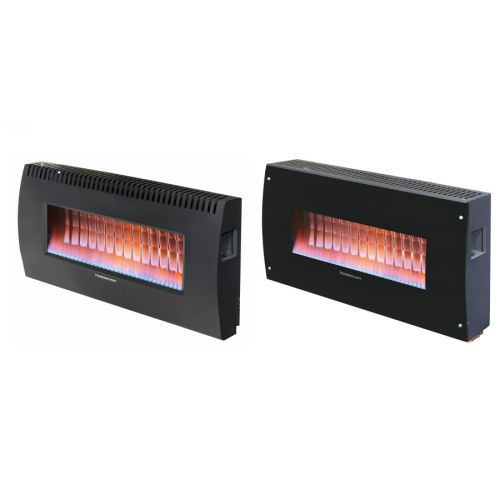
In the rating of wall-mounted gas convectors for the home, the model received gold Hosseven HP-3.
Main characteristics:
- wall;
- heats up to 30 sq. m;
- power 3 kW;
- weight 28.5 kg;
- thermostat;
- temperature adjustment;
- mechanical control.
First of all, the unique design of the device catches your eye: the case is black, the front panel is made of heat-resistant, impact-resistant glass.Very reminiscent of a fireplace.
This stationary heater can work both on main and balloon gas.
Heats the room quickly, looks great.
The price of the model is an average of 25,000 rubles.
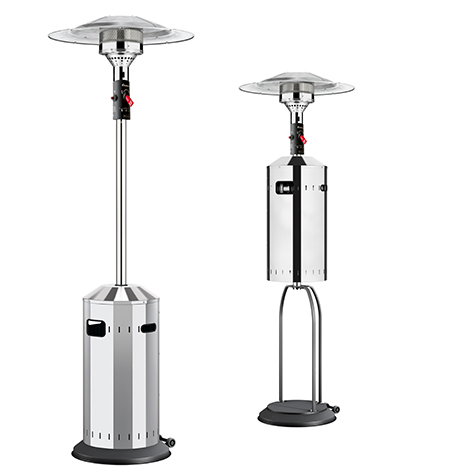
Rating of street models topped Enders elegance.
Main characteristics:
- street;
- diameter of heating - 9 m;
- power is 8 kW;
- weight 12.5 kg;
- height 2.2 m;
- wheels for moving;
- shutdown when tilting more than 45 degrees;
- mechanical ignition.
This model is perfect for gazebos, porches and other outdoor recreation areas or cafes. Thanks to the stylish appearance, it will not only fit in, but also decorate any place.
The device used the new Enders-Eco-Plus technology. That it provides heating at 12 kW with a real power of 8 kW.
The average cost of such a model is about 24,000 rubles.
Conclusion
There are many worthy models for various purposes, and listing everything is quite difficult. We selected the most popular ratings and introduced you to their leaders. We hope that our article will help you make the right choice.
Heat your home!


hi !! is it possible to dry the underground in a wooden house with a gas heater ??