Today it is difficult to imagine that someone does not have a camera. And if not, then he will certainly appear in the near future. However, what kind of equipment will it be and what will it be capable of? Even non-professionals are aware of the presence of “DSLRs” and that they are much better than “soap dishes”. The current classification of cameras is not limited to these options. So, to choose the right model for yourself, it would be nice to know the main types of cameras.
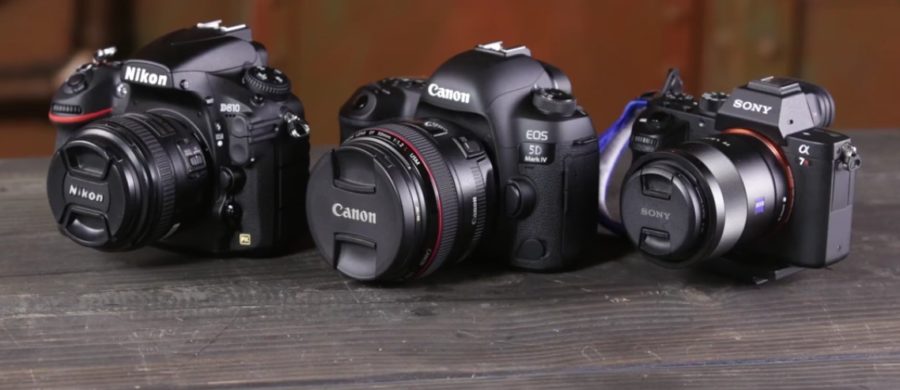
Classification
Since today the bulk of the use of digital cameras, it makes no sense to talk about their predecessors - film. Although, thanks to them, photography has become available to ordinary people. This, by the way, is one of the options for classifying cameras. There are others. However, many of them are understood only by professionals, and it makes no sense to focus on them.
In a broad sense, all available models of digital photographic equipment can be divided into 3 categories:
- Compact.
- Mirrored.
- Hybrid
Obviously, among them there is no ideal apparatus. Depending on the situation, each camera has its own advantages and disadvantages. That is why they coexist peacefully in the market and find their consumer without difficulty. However, to understand which option to choose for purchase, you should carefully study all types of cameras.
Compact cameras
This category with someone’s light hand in the common people is also called “soap dishes”. And really the simplest compact models inoperative resemble this household item. However, do not immediately reject them and say that such cameras are suitable only for beginners. Among them there are interesting models that in some cases will be of interest even to high-level professionals.
First you need to understand the design features of this type of camera. They are distinguished by their small size, non-removable lens and small resolution of the matrix. The first quality is a definite plus of these cameras. However, for small dimensions you have to pay for the deterioration of other characteristics.
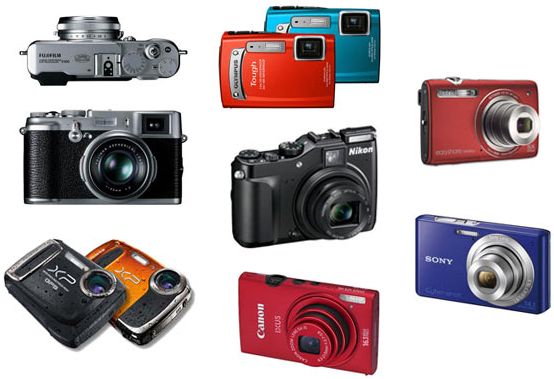
So, compacts usually do not have glass optics, which degrades the quality of shooting. What does this mean for the average consumer? Ready-made photos with the same sharpness shoot objects in focus and out of it. Truly high-quality shooting is possible only in good daylight, preferably on the street and at a certain distance from the subject. Of course, this limits the ability of the photographer.
In addition, to reduce the cost in the "soap dish" uses the matrix with the lowest resolution. Usually from 1/3 ”to 2/3”. It also does not allow to obtain high-quality images in any conditions. For example, when using the compact, you should forget about shooting at night or moving objects. Photos will be blurry and dark.
However, for household shooting, a compact camera can be quite convenient. Most of them work on a “click and finish” basis. No need to make any manual settings and focus on the subject for a long time. The manufacturer provides several options for automatic shooting, where suitable characteristics have already been selected. In more advanced models, the lens can be equipped with a zoom, which allows you to adjust the focal length.
Another undoubted convenience of compact cameras is the display viewfinder. On the external screen, the photographer sees the same picture that will turn out on the finished picture. True, on a sunny day, the LCD screen will display a brightened image, and the shooting will have to be done almost blindly. In this case, the electronic viewfinder, which is available in almost all such cameras, can help.
In conclusion, I would like to note that compacts are the simplest models of cameras. They can help out if it is inconvenient to take a DSLR with you, and shooting is supposed to be done on the street. And, of course, they are suitable for all those who do not want to delve into the intricacies of the manual settings of professional photo equipment. Those who are willing to pay a little more and get the quality of images close to the “DSLR” should pay attention to prosumer cameras of this category.
SLR Cameras
Undoubtedly, today they are the most popular cameras among professionals. There are many reasons for this. However, first you need to understand its design features. This will help to understand why the quality of SLR images is much higher than those made by the compact.
The main differences between this type of camera from others are:
- removable lens;
- optical viewfinder;
- high-resolution matrix (from ½ ”);
- Manual settings are preferred for shooting.
All together, you can get high-quality images that are so expected from professionals. To understand whether you need to buy such a camera for yourself, you should understand each of these qualities in more detail.
So, how does the DSLR work? The image through a complex optics system (it is always glass in these cameras) is reflected in a mirror, which is located at an angle of 45 degrees with respect to the viewfinder. As a result, the photographer sees the same picture that turns out in the finished picture. Deviation is not more than 5%. Even film beloved by some professionals cannot boast of such quality.
As soon as the photographer sees the picture he needs through the viewfinder, he presses the shutter. At the same second, the mirror rises and the light hits the matrix. A distinctive click is heard and the picture is taken. Less than a second elapses between the shutter release time and the press of a button, which allows you to shoot moving objects and take continuous shots.
However, without a high-resolution matrix, getting a high-quality image is quite difficult. Even in the cheapest DSLRs, it is no less than ½ ”. Professionals prefer to choose models with a full-sized matrix. What does this give in the end? Of course, more realistic and high-quality images. The larger the matrix, the larger the photocell, and hence its photoelectric characteristics are better.
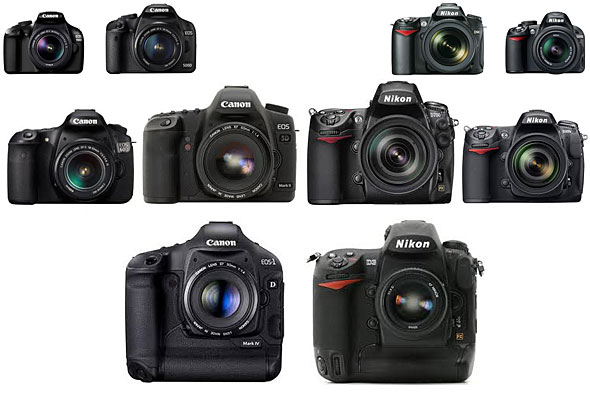
Another point that you should pay attention to when buying a SLR camera is a removable lens. In the case of semi-professional equipment, usually one is included in the kit, with some averaged parameters. However, if we are talking about a SLR camera for the pros, then only the “carcass” is usually sold. But a set of lenses (usually to expand its capabilities need 2-3 pieces) is purchased separately.
The last quality of all SLR cameras is manual shooting settings. For professionals, this is undoubtedly an advantage. After all, they can configure everything as required. But it can seem complicated to the layman. Without preparation, it’s more difficult to take high-quality images with a DSLR than with a soap box. However, this fact is taken into account in semi-professional technology, and management is made intuitively clear. In addition, the main control buttons are displayed on the body, which allows you to quickly and easily configure the desired shooting mode.
Perhaps, the main disadvantage of "DSLRs" is still the high price. Some models are not available even to professionals. The price tag for them starts from 20 thousand rubles. But you still need lenses and other consumables (memory cards, batteries, cables, etc.). Moreover, the price for professional cameras will already be at least 50-60 thousand rubles. Of course, not everyone decides to pay such an amount for the camera for themselves.
Hybrid cameras
In recent years, the so-called hybrids or “mirrorless” have appeared, significantly displacing other types of digital cameras from the market.They, like SLR cameras, allow you to get high-quality images. However, their work is based on a slightly different shooting principle, which does not require a mirror. Otherwise, it’s the same “DSLR”. To understand the pros and cons of the hybrid, you should carefully study its technical characteristics.
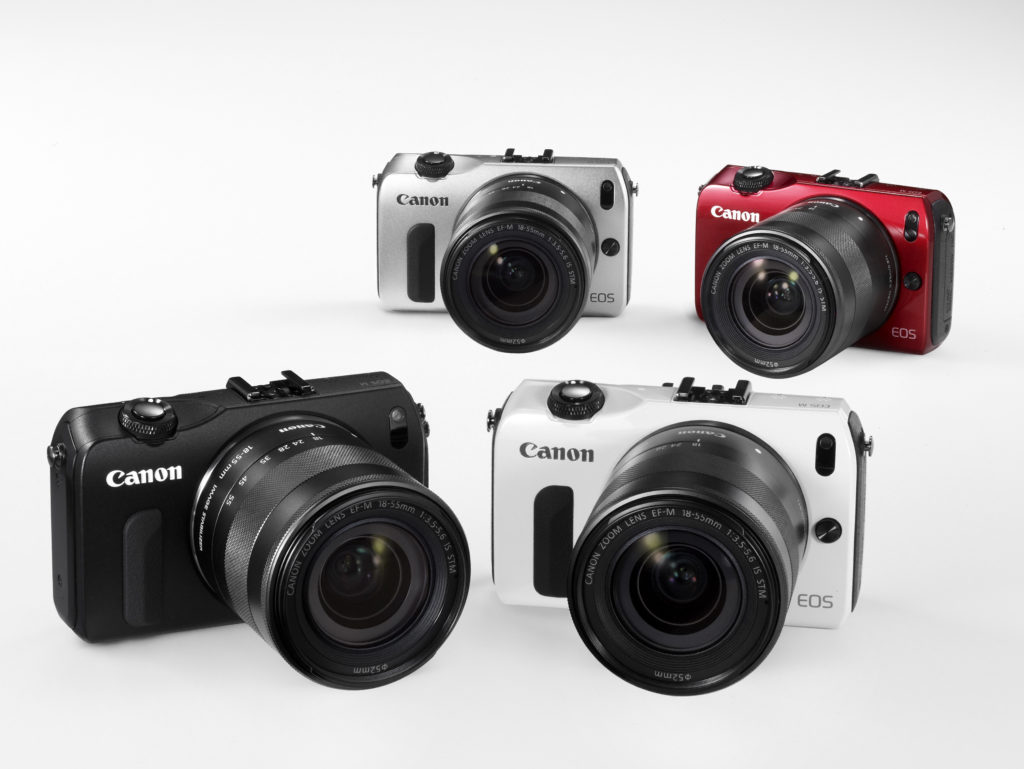
This type of camera is not in vain received this name. It combines the advantages of compacts and DSLRs, namely:
- compact sizes;
- removable lens;
- large matrix (like budget "DSLRs");
- affordable price.
Due to the fact that the manufacturer managed to remove the mirror and the prism system, the dimensions of the hybrid camera are comparable to compacts. This also reduced the cost. Today, a good hybrid can be bought for the same amount as a budget SLR. Of course, this led to the fact that many turned their attention to such cameras. Especially those who purchase equipment for their own needs.
However, in order to make the hybrid smaller, the manufacturer still abandoned the optical viewfinder in favor of the display. Sometimes it is supplemented by optical parallax. Of course, this is a drawback. However, this does not affect the quality of the images. Indeed, in most hybrids, a matrix with good resolution is like budget SLR cameras. In the last year or two, hybrid cameras with a full-sized matrix have appeared.
To bring them even closer to SLR cameras, manufacturers equipped the hybrids with removable lenses. This is without a doubt a plus. True, one will still be included. As in the case with "mirrors", it will be with some averaged parameters. For special shooting options, an additional lens is already required. And, of course, manual settings are given priority in hybrid cameras.
Among the shortcomings of these cameras, one can also note the fast consumption of batteries. This is mainly due to the fact that an electronic viewfinder is used. Also a lot of energy is consumed during shutter release. Unlike DSLRs, it is silent. The speed of its operation, however, is slightly lower than that of similar SLR cameras.
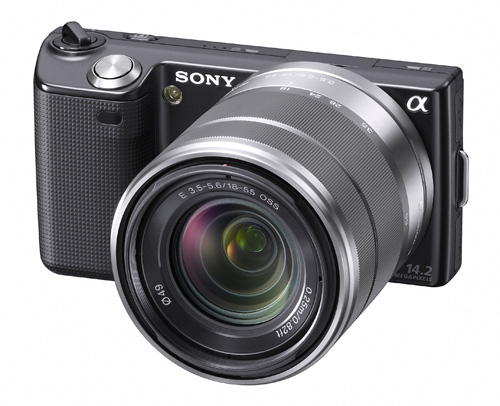
In general, you can recommend hybrids to those who would like to get good pictures, but are not ready to lay out a round sum. Of course, it is suitable for amateur photography and even for professional, but with some limitations. Some photographers even have one such camera in their arsenal for those cases when the dimensions do not allow taking a DSLR with them.
Instead of an epilogue
If you ask which camera is the best, of course, many will answer: “Mirror”. However, those who know the types of cameras well and their differences will not give such a clear answer. So, compacts can be recommended to anyone who does not want to think about the settings. "DSLRs", of course, are needed for professional shooting. Hybrids can be advised to those who want to get good pictures, but can not afford an expensive camera. Of course, all 3 types of cameras perform the same function. However, replacing one camera with another will not work. Too different image quality.


