 The issue of heating residential or public buildings, where there is no central heat supply system, has always been very acute. It is even more important in places where there is no gas, it is impossible to install a heating boiler. In modern dachas or in country houses, furnace heating is inefficient - the cooled house will have to be heated for almost a day, and if the trip is planned for the weekend, then by the time you reach a comfortable environment, it's time to get ready to leave. The new generation ceiling infrared heaters solve many problems; they are efficient, simple, safe and reliable.
Content
- 1 How it works
- 2 What is the main difference between different classes of heaters
- 3 What are the criteria for choosing the power of an infrared heater
- 4 The influence of the design of the device on the heating characteristics
- 5 Characteristics of heaters depending on the thermal element
- 6 Comparison of popular brands
- 7 In conclusion
How it works
The principle on which a modern ceiling IR heater works is the transfer of heat by radiation in the same way as the sun does. The following happens:
- under the influence of electric current the thermal radiating element is heated;
- infrared radiation, depending on the type of heater, is characterized by a different wavelength. It transfers thermal energy to floors, walls, people and interior items that are in the coverage area of the heater;
- air is heated not from the temperature emitter of the installation, but from objects and structures to which energy is transmitted.
Modern heaters are comfortable. They are equipped with protective equipment, which includes both electrical control systems and temperature sensors. The case of the device is insulated, its temperature is low, many models allow mounting directly on wooden structures. The level of heat transfer is regulated by thermostats, the heater is economical, the standard rate of conversion of electric energy is 70-90%.
It is worth noting separately the group of heaters that will not be considered. Powerful, suitable for servicing huge garages and hangars infrared emitters operate on gas. Fuel burns in a finely dispersed, lattice ceramic structure, while an open flame practically does not form - catalytic burnout occurs. The temperature of ceramics reaches enormous values, so the level of heat transfer is very high.
Among the companies that offer domestic ceiling-type heaters, only BALLU can be noted. However, for products of this brand it will be necessary to make a gas supply, to arrange a system for removing combustion products (for some models), which is rather inconvenient and almost always expensive and difficult in an apartment, house, or summer residence.
What is the main difference between different classes of heaters
All new-generation ceiling electric infrared heaters are divided into three classes according to the radiation characteristics. They differ in both visual impact and heating capabilities.
- Short-wave emitters are able to very warm the room, their thermal element develops a temperature of up to 1000 degrees. Short-wave class heaters quickly give off heat flux, when placed at a low height they form a zone with a strong temperature increase, they are recommended for use in rooms of a large area, with high ceilings.
- Medium-wave heaters are considered optimal. They are placed at a height of 3 to 6 meters, work great both in cottages and in apartments, as well as in large public areas. Thermal elements reach temperatures up to 600 degrees.
- Longwave - the most inexpensive and practical.They are recommended for use in rooms of small area, with ceilings below 3 meters, the thermal element can vary the temperature from 100 to 600 degrees. This class of devices is often performed in a universal format: the heater can easily be hung on the ceiling, mounted on a vertical rack or on supports, directly on the floor.
Regardless of the class by wavelength, infrared heaters safe: their case is not heated, the design and location prevent access to the heating parts of the emitter. In practice, you can especially focus on short-wave models. Their excessive power is invisible when installed on a high, more than 6 meters, ceiling.
However, in a room such heaters create a clear zone, being inside which for a long time a person begins to experience discomfort. The body simply overheats, the skin and cornea of the eyes dry, other unpleasant sensations arise.
In addition, if the room has not yet warmed up, the exit from the radiation coverage area is immediately felt, it becomes cold. Therefore, it is worthwhile to use short-wave models carefully, carefully choosing them by power, planning the area captured by the flow of heat waves.
What are the criteria for choosing the power of an infrared heater
The basic method of choosing a new generation heater is quite simple. It is recommended to take 100 watts of electric power per 1 sq.m of heating area. The assumptions made are:
- if the room freezes, it is rarely used and therefore a quick warm-up is needed - it is necessary to increase power requirements by 15-20%;
- The most popular medium- and long-wave heaters have a power of up to 1500 watts, so it is recommended to choose two or more devices for a room more than 10-15 square meters.
To understand how to choose the layout of the emitters and their number, you need to consider the engineering performance of a particular model: the configuration of the reflector and the scattering angle of the heater.
The influence of the design of the device on the heating characteristics
In the characteristics of the heaters, responsible manufacturers must indicate such a parameter as the scattering angle or coverage. This figure is quite simple to understand: it describes the conditional triangle of the divergence of the boundaries of the zone where infrared radiation has an almost stable intensity. The higher the value of the angle of coverage, the larger the area heats the device and the more evenly, softer it distributes heat.
The angle of coverage depends on the configuration of the reflector and the front screen. To understand which is the best of the heaters, the manufacturer of which did not indicate a specific characteristic, it is possible by their appearance:
- for models with a flat front (lower part) and a semicircular reflector, the coverage angle rarely exceeds 90 degrees;
- for products with a semicircular lower part and a flat reflector, the effective coverage area is 90-120 degrees;
- models with a tubular design of the emitter, regardless of the type of reflector, have a minimum coverage of 120 degrees.
Of particular note: we are talking about the radiation propagation zone, where its intensity is almost the same. In fact, all heaters heat wider than the coverage sector, but outside of it, the heat output drops significantly.
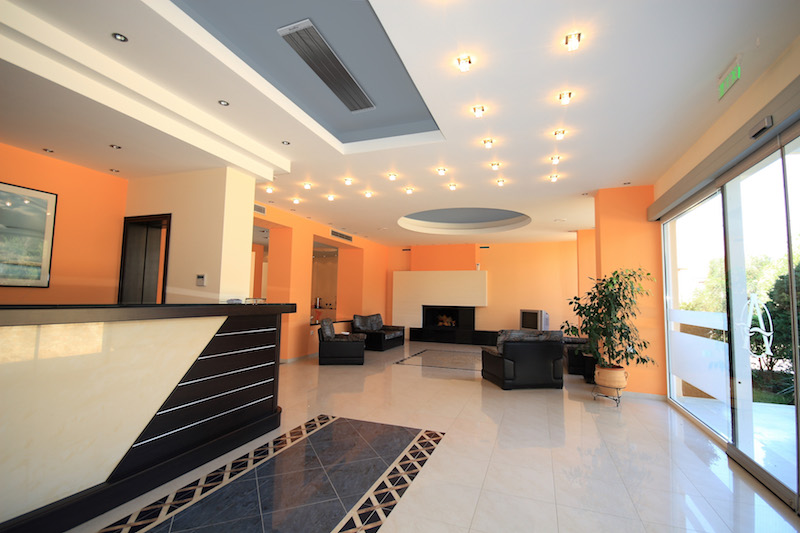
Depending on the coverage specified by the manufacturer or visually determined, you can calculate where to place the emitters in order to efficiently distribute the energy in the room. It is enough to draw a diagram on a piece of paper on a scale and, using a ruler and a protractor, place the attachment points of the heaters so that their dispersion zones do not intersect.
Characteristics of heaters depending on the thermal element
Depending on the type of heater used, not only the wavelength of the radiation and the level of heat transfer are different, but also the visual impact on the person and the MTBF of specific devices. In particular:
- models on halogen lamps are considered the most uncomfortable, unsafe, therefore they are not common. The source of heat is a tungsten filament in an inert gas flask. The lamp emits a pulsating golden light. Despite the fact that manufacturers cover the emitter with special compounds, the heater can irritate the eyes and cause headaches with prolonged exposure to human vision;
- the most common short-wave emitters generate heat using a hot carbon fiber spiral in a tube from which air is pumped. This class of heaters is familiar to everyone. Devices quickly heat up, are afraid of humidity, emit visible red-orange light, causing fatigue and discomfort. In addition, the time between failures of a fuel element is low - only two years;
- ceramic medium and long wavelength emitters are considered the best choice. Such a device does not emit visible light, has a huge MTBF, it is recommended for long-term use: a ceramic structure slowly heats up, but also gives off heat for a very long time, the heater is very economical;
- Tubular or micro-thermal heaters are the development of ceramic emitters. Heaters with such a thermal element of the road, however, are very reliable and practical.
The generation of heaters on tubular ceramic emitters has another feature. They make a slight crack during operation. Many manufacturers position this feature as some stylistic feature: they say, it is very similar to the sound of fireplace wood. However, in the ceiling heater, this "trick" looks somewhat strange.
Comparison of popular brands
In order not to reduce the story to bare figures and calculations, we give a rating of brands widespread on the market and indicate the features of various models of heaters.
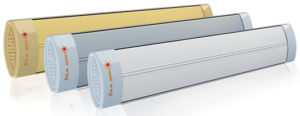
- PEONY. The development of the Russian, the best heaters for a variety of estimates. In the first place, experts put the energy efficiency of devices: they are able to convert up to 90% of electricity into heat. The first generation of heaters was built on tubular thermal elements, it issued a crack. Modern models use ceramic plates, work quietly, have a very long service life. The coverage angle is 120 degrees.

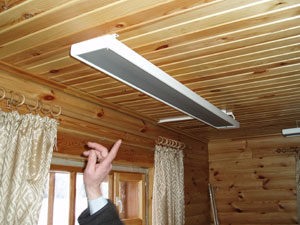
- ECOLINE. Long-wave infrared heaters, the advantages of the models include high heat transfer, an excellent combination of price and quality, a wide range of products for different floor areas and ceiling heights are offered. Radiation Coverage - 90 degrees.
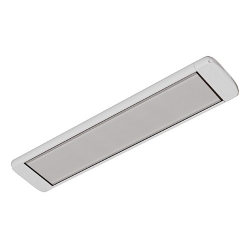
- BILUX. Heaters of the medium-wave segment, the heating system is built on heating elements that transmit heat to the radiating plate. The coverage angle is 90 degrees, it is recommended to mount the devices on suspensions: a polymer felt is used as a thermal insulator, therefore installation on a wooden ceiling is not recommended.
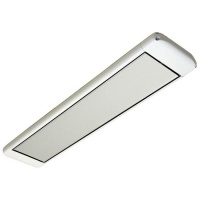
- ALMAK. Devices (most models of the manufacturer) use a tubular heater with a carbon spiral, belong to the short-wave segment, and have good heat transfer. The coverage angle is 90 degrees, a limited installation height is a feature of the devices, the manufacturer also notes this: it is recommended to use in rooms with ceilings not higher than 3.5 m.
UFO, Polaris, other popular cheap heaters have good price and quality indicators. This class of devices uses a quartz heater, most devices are intended for domestic use.
In conclusion
Concluding the review of technologies, characteristics and selection criteria for infrared heaters of the ceiling type, it is worth giving a list of their advantages. There are a lot of them:
- warming up the room is quick;
- the heat generated by objects in the room, walls and floor has the main advantage. The microclimate lasts a long time, the room can be ventilated without fear of much cooling;
- the life of infrared emitters is long, with the exception of quartz models with a fixed mean time between failures - about 2 years;
- appliances are completely safe;
- radiation, body temperature cannot cause a fire, heaters are allowed to be mounted on wooden ceilings;
- devices do not take up space, it is easy to choose a product for a specific interior or prefer a built-in model.
Ceiling heaters create uniform heat, do not raise dust, do not burn oxygen and do not exude unpleasant odors. The disadvantage is the relatively high price of products. However, it is easily compensated by the efficiency and economy of infrared heaters of the ceiling type.